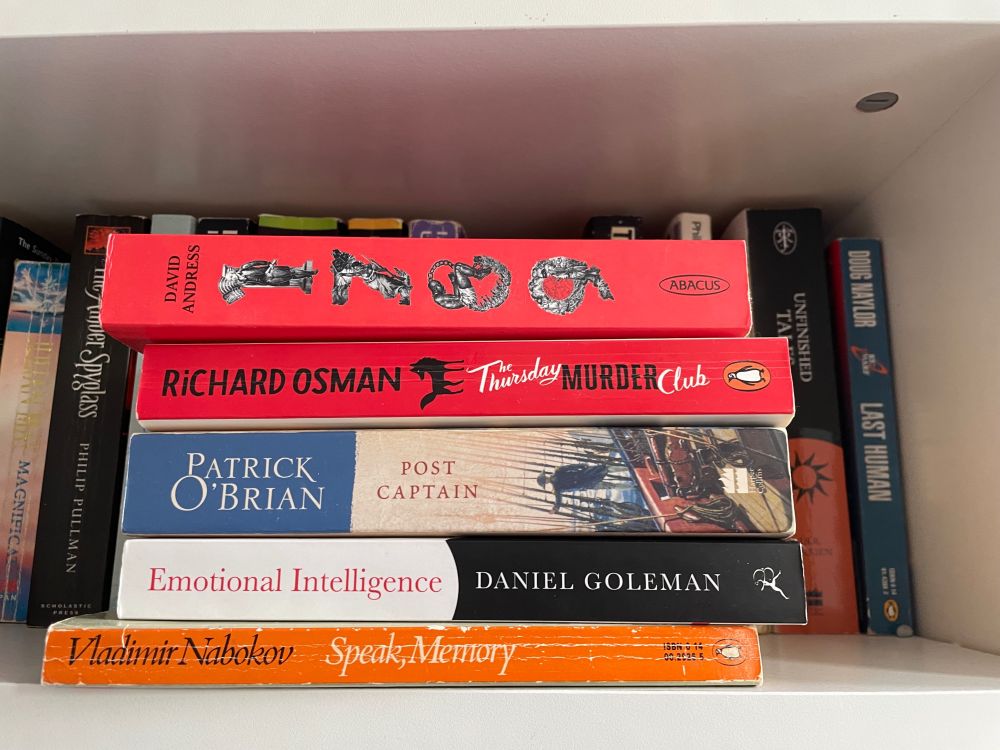
I have finally achieved the ambition of any literary person: to finish reading every book in my house*. Most prominently, what I call the ‘pile of shame’: a teteering stack of random books purchased from charity shops.
Second-hand books are one of the cheapest things you can buy in London, at about £1 each. When I am on my lunch break I sometimes suffer a kind of boredom spasm**, where I NEED to buy something, and end up grabbing whatever seems briefly intriguing.
It turns out that if you buy a meal deal*** worth of books at random every week, you end up with a lot of unread books.
With focus, lots of reading time, and carefully avoiding book deals on my Kindle, I finally cleared them all. Judge for yourself if I was lucky with my choices.
Hickory Dickory Dock, Agatha Christie
One of Christie’s pacier and better-plotted stories. Benefits from being obscure, meaning the solution hasn’t leaked to the general public.
The story centres on a group of students at a hostel run by a bad-tempered miser. Several random objects are mysteriously stolen- a stethoscope, a diamond ring, several light bulbs. The famous detective Hercule Poirot is brought in to investigate because his secretary’s sister happens to manage the establishment. Before long, the hostel is swimming in murders.
The best aspects of Hickory Dickory Dock are its well-observed depiction of relationships between a group of young people, and its storytelling efficiency. The book is under 200 pages and flies by, with no wasted space but plenty of intrigue and red herrings. It’s a demonstration of utter genre mastery by Christie.
The Thursday Murder Club, Richard Osman
Probably the closest modern equivalent to Agatha Christie, at least to the casual reader.
The Thursday Murder Club stories are the cosy mystery’s cosy mystery; any hint of threat has been carefully sanded down, leaving something as inoffensive as a packet of Werther’s Originals in front of a Midsommar Murders re-run.
It Starts with Us, Collen Hoover
Colleen Hoover has admitted that there was no need to write a sequel to It Ends With Us. The protagonist’s biggest problem was already fixed in the previous book, and there is no conflict left to resolve.
As a result, It Starts With Us is 300 pages of a fundamentally nice couple deciding whether to pursue a relationship. Spoilers: while there are a few external obstacles, like Lily’s abusive ex, the ending is not a surprise.
It Starts With Us is difficult to dislike because it is essentially a reward for Hoover’s loyal fans who made the first book a success. At worst, the prose is a bit flabby, the plot is melodramatic when it isn’t predictable, and the excessive letter-reading is annoying.
It is overall an unobjectionable cake made entirely out of icing.
The Lost Continent: Travels in Small-Town America, Bill Bryson
‘I came from Des Moines. Someone had to.’
An early work by travel writer extraordinaire Bill Bryson, which shows an edgier side compared to his recent books. I didn’t enjoy some of the off-colour racial dog whistles which passed for humour in the 1980s.
Emotional Intelligence, Daniel Goleman
I was expecting a standard airport book but instead found one of the most enlightening things I have ever read.
Goleman convincingly makes the case that self-control and the capacity to ‘read the room’ matters more to people’s lives than intelligence or any other inherent ability. Brilliant. Everyone should read this.
Post-Captain, Patrick O’Brien
An exciting and funny installment of the dad-coded historical novel series. The plot is a bit episodic and lacking direction, but Jack Aubrey and Stephen Maturin are such a fun pair of characters it hardly matters.
The captain and the doctor are perfect comic foils, with Jack’s blundering lack of diplomacy on land counterbalanced by Stephen’s near-suicidal inability to grasp the basics of seamanship. The subplot with the bees made me laugh out loud several times.
Patrick O’Brien has a method for making a different era relatable: piling on details. The density of historical information is overwhelming at first, but after a while, it makes the world feel lived-in and plausible. This book will leave you feeling educated enough to sail your own frigate into battle.
1789: The Revolutions That Shook the World, David Andress
A pretty mid history book. Didn’t mind it.
Speak, Memory, Vladimir Nabokov
Author Vladimir Nabokov recounts his childhood in pre-revolution Russia, his career as a precocious literary genius, and his relationships with his parents, brothers and various girlfriends.
Nabokov just writes better than almost anyone else. I don’t enjoy autobiography and this was still a terrific read because of his prose.
Conclusion
Before purchasing books remember that they take a long time to read, and that if you buy too many they will not fit into your house. The solution: buy a larger house.
*Library books don’t count.
**A very real condition, don’t look it up.
***A Tesco meal deal, consisting of a sandwich, crisps and drink, is £4, and +- the cheapest lunch you can buy in London, where everything else costs at minimum £11.85.
 Chris Barker
Leave a comment