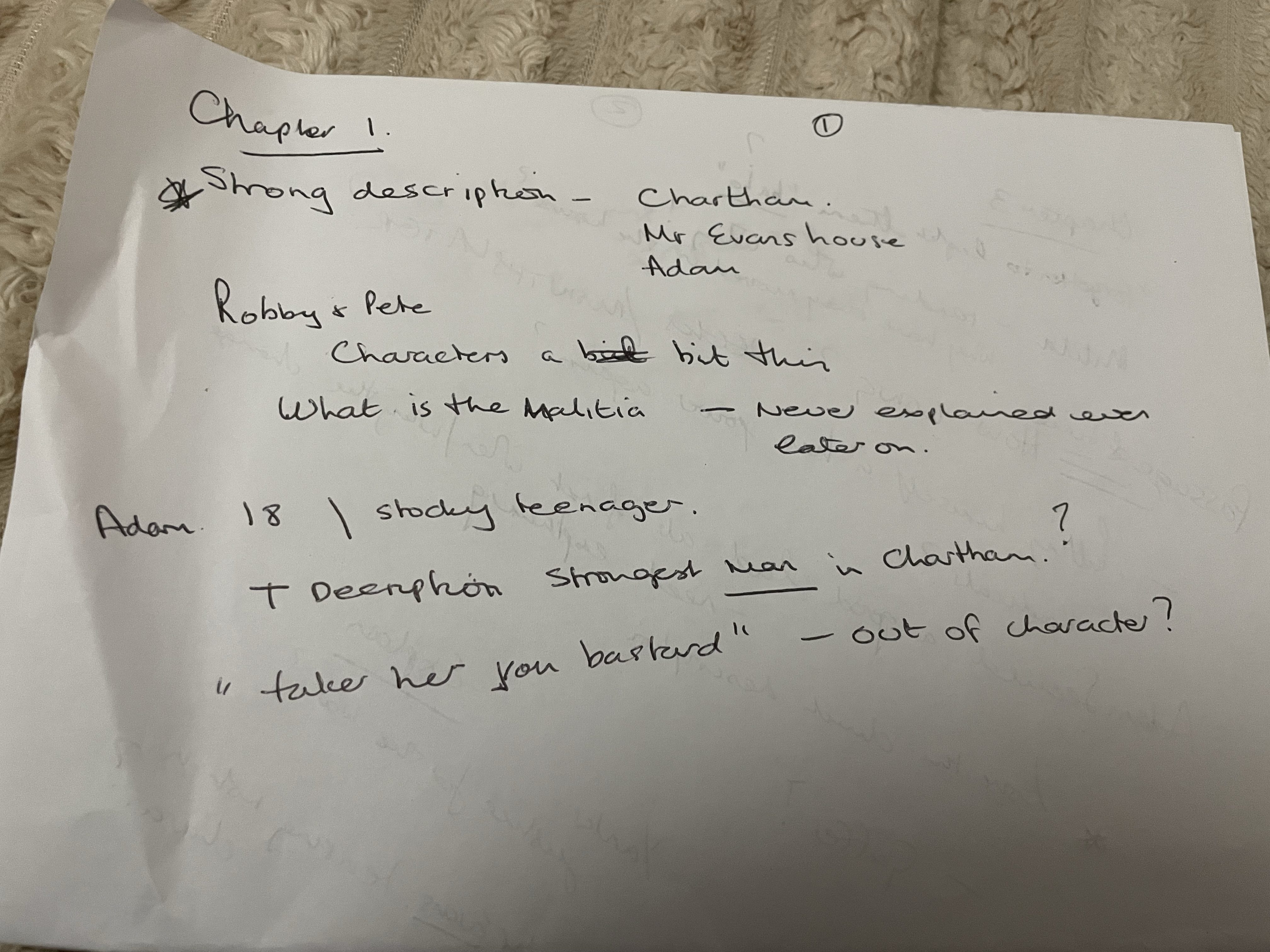
Around 2023 I decided it was finally time to write a full-length novel.
No-one in my family is a writer, I studied History instead of English Literature at University, I’m not a MFA, and while I read around 50-100 books per year,1 I’ve never formally studied them.
What I have in my favour is an itch to write fiction, which started when I first read Roald Dahl2 as a little kid. I spent years obsessively reading blogs and watching YouTube videos about narrative and character arcs and writing, while never quite taking the plunge and doing it myself.
There were a few short stories which never saw the light of day, and a lot of pop culture blogging and film reviews, but rarely anything which went beyond 1,000 words3.
Considering that I had a full-time job, the idea of writing a novel seemed insane: the kind of thing that a literature professor or a retiree might do in his spare time, rather than something practical.
Why I thought I could do it
At the time I had been writing film reviews every week since 2019. My usual format was a four-to-six-hundred word review twice per week, or about 1,000 words per week. They were very helpful for developing my voice and confidence.
After a few years, it occurred to me that most books are about 50-100,000 words long- in other words, if I stopped writing film reviews, I could write a full-length book in about 1-2 years.
My background in business journalism gives me several advantages. I am used to sitting down and writing every day, I can basically string a sentence together4, I don’t mind deadlines, and I’ve developed a thicker skin than most towards rejections.
Options
My three ideas for a novel were a near-future story about a dystopia with 50% unemployment (topical), a dark MeToo-era drama (topical, yet controversial), and a 1920s alternative-history novel with horror and fantasy elements (not topical, also controversial).
I decided on the third, because I enjoy making trouble for myself.
Planning
Before starting I attended several courses and read a small library of books about how to write a novel. The amount of information was dizzying: it was too much to process.
I decided to follow the method outlined in Stephen King’s On Writing: six days a week, no music or film on in the background, at least 1,000 words per day, and the first draft is allowed to be terrible. That seemed simple to follow at least.5
I’ve always found it easiest to make a detailed outline before starting any project. I wrote a bullet point summary of each chapter, scene-by-scene. The focus was the main events of the chapter and the character arcs: some were a lot briefer than others, and a lot of them changed as I was writing as I realized I needed to justify events later in the story.
My expectations were low: I thought it might take me years to finish a first draft. I wasn’t sure whether I would keep blogging in the meantime, but if fiction became a slog, I could always lean back into the film reviews and let the novel fade into the background.
The first year
It did not take me years to write a first draft.
The great thing about writing 1,000 words a day, even if they are stupid, terrible, dumb words, is how quickly they accumulate. The average book is 60-90,000 words long. In theory, that means that a writer can produce a first draft in about three months. In practise, because of days off and life getting in the way, it took me almost five.
Going from 1,000 words per week to 1,000 per day was an adjustment, but not as big a one as you’d think. The Stephen King method really works. Turn the TV off, kids.6
My method was to get up around 6-6.30am and do the bulk of the writing before anyone else in the house was awake. This meant fewer distractions, and writing first thing made it easier to connect with my unconscious and all the crazy stuff I needed to access to write horror/fantasy.
It normally took about 1-2 hours to hit my wordcount, but I had good days and bad days. I am a visual person, and there were scenes which already seemed to exist in my mind, which I just needed to write down. I often blew past my wordcount easily on those days.
On the other hand, there were more plot and exposition-heavy chapters which were a real slog, and sometimes I would put in a bunch of crap I would need to cut out later just to meet my word count. (I do not recommend that method).
The big challenges
Probably because I was used to thinking in terms of visuals, I would write a lot of things which would make sense in a film because the missing pieces could be filled in by acting, then discover that my readers didn’t really get them. I often had character arcs, in particular, which didn’t come through the first time I wrote them and where I found that I needed to be more explicit.
I was inexperienced in my first two drafts, which were basically me learning how to write in a new style. After that,things became easier.
Also: timelines are surprisingly hard to get right. The book went through four different alpha/beta readers without anyone noticing that the timing of the plot was impossible.7
People just seem to stick with the logic of stories while they are reading them, and so long as things ‘feel right,’ they don’t tend to sit down and work out how long things actually took, and whether they make sense. Including the author, apparently.
Next steps
The Grave War has been through multiple drafts and many, many readers at this point, and I’ve moved on to the next stage: querying. Which is a completely different skill to writing.
I will write another blog post in the future (potentially the very distant future) to tell you how that went.
Conclusion
The Grave War exists. It is a book-length object with a beginning, a middle and an end, which you can read. Whether it is any good is a matter of opinion.8 The point is that it was doable, even with a full-time job and a life.9
I believe creating a book is something everyone who considers themselves a writer should attempt, if only for the experience. If I did it, you can do it.
*******
- Looking after a baby is both good and bad for my reading. On the plus side: you are often stuck in one place for a long time. On the minus side: hard to read in bed, since pages rustling or nightlights instantly wake her up ↩︎
- Problematic fave ↩︎
- Don’t look for my pre-2019 work, it’s mostly bad. ↩︎
- Although you be the judge of that ↩︎
- King has been known to write 5,000 words per day, but that’s frankly nuts. ↩︎
- For obvious reasons I wrote a lot of my film reviews in front of the TV. ↩︎
- In one storyline some characters go and do something which takes 3 days. Two other characters go and do something which takes two days. Then, they both experience the aftermath of the first characters’ storyline. No-one noticed!
I am currently writing another book, and making the timelines line up for that is also the most difficult part. ↩︎ - If you’ve read it and you think that it is good, feel free to leave a five-star review. If you think it is great, make a few fake accounts and leave several five-star-reviews. Disclaimer: not legal advice. ↩︎
- What I consider a life anyway ↩︎
 Chris Barker
Leave a comment